
beer
The global craft beer industry is experiencing continuous growth, and Thailand is no exception. A notable trend is the incorporation of local ingredients to create unique flavors and identities for craft beer products. At Mahasarakham University, researchers have developed a project focusing on the use of local fruits to enhance the aroma and taste of craft beer. This research not only enriches the flavor profile and identity of Thai craft beer but also ties into broader economic benefits and community development.
Enhancing craft beer with local fruits is more than just product innovation, it represents a strategic approach to boosting the local economy, generating income for communities, and positioning Thailand within the international craft beer market in an environmentally sustainable way.
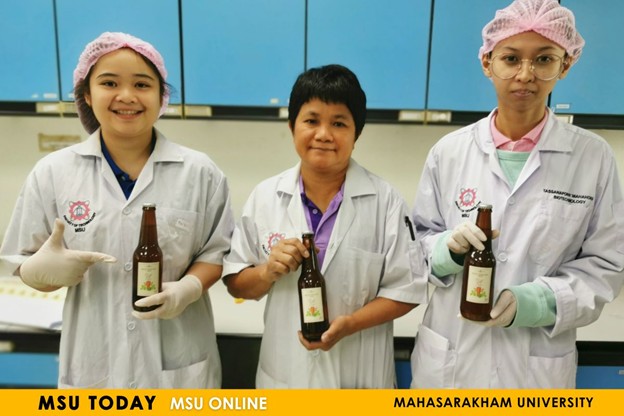
This research highlights the potential of local raw materials in adding value and driving the sustainable growth of Thailand’s craft beer industry. The project is led by Pa-Nga Yeunyaw,Ph.D., a faculty member of the Department of Biotechnology, Faculty of Technology, Mahasarakham University, along with her dedicated research team.
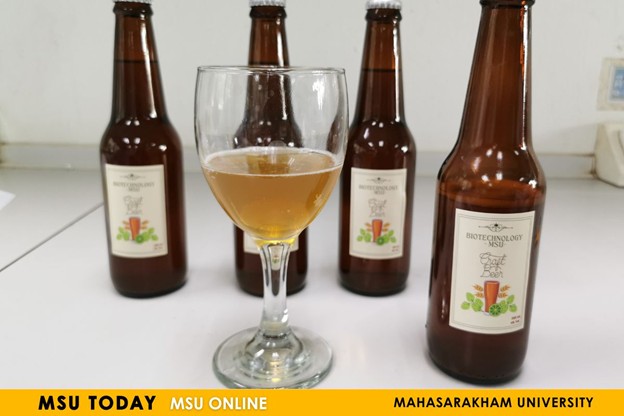
Background of the Research
The craft beer industry has seen remarkable global growth, and Thailand is beginning to follow this trend. Thai consumers are increasingly drawn to craft beers with distinctive and personalized flavors. The Thai craft beer market has been growing at an average rate of 15–20% per year, and in 2023, American-style craft beers, known for their unique character, gained significant popularity among consumers.
In response to this trend, the Faculty of Technology at Mahasarakham University assigned the Department of Biotechnology, which has expertise in microorganisms and alcoholic fermentation, to conduct training and workshops on craft beer brewing. These events were held on September 16, 2023, and again at KHAI LAO Co., Ltd. (Head Office) in Lampang Province from November 17–19, 2023, to share knowledge with interested participants. The department also showcased the craft beer production process at MSU Open House 2023 and 2024, and brewed beer for interested buyers.
However, one key challenge remains: the high production cost, primarily due to the need to import malt and hops, the essential ingredients in craft beer. This challenge became the motivation for initiating research into the use of local fruits as a substitute for hops to add flavor and aroma to the beer. The goal is to create a uniquely Thai craft beer that reflects the character, aroma, and taste of locally sourced fruits, while reducing reliance on imported materials.
Highlights of the Research
This research stands out through its innovative approach to using local fruits as a substitute for hops to naturally enhance the aroma and flavor of craft beer. In addition, it introduces a fermentation technique that employs commercial yeast strains capable of thriving at room temperature, significantly reducing the need for temperature-controlled fermentation chambers and thereby lowering energy consumption.
Moreover, instead of using the conventional force carbonation method, the study adopts a natural carbonation process during the priming sugar stage, allowing carbon dioxide to be generated organically during secondary fermentation. This not only results in a smoother, well-balanced beer but also helps to reduce production costs by eliminating the need for expensive CO₂ tanks and pressurization equipment.
Through this integrated approach, the research delivers a more sustainable and cost-effective brewing method that maintains high-quality sensory attributes while promoting the use of locally available raw materials, strengthening the identity of Thai craft beer.
Unique Features of the Product
This craft beer offers a fruity aroma from fresh fruits added during fermentation, with a sweet-and-sour flavor profile from lychee and passion fruit, giving it a unique Thai twist.
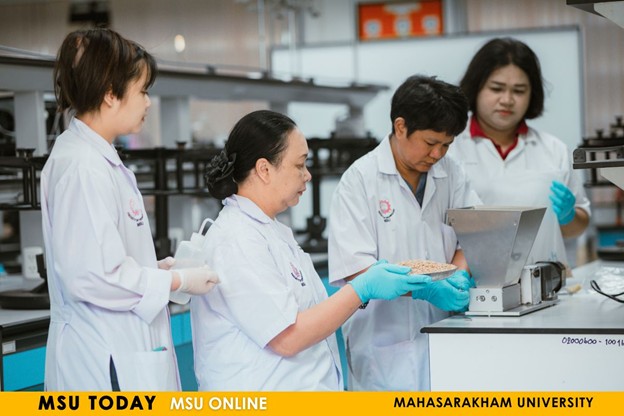
The process of brewing beer involves several key steps, each with its own level of complexity.
Here’s an overview of the production steps:
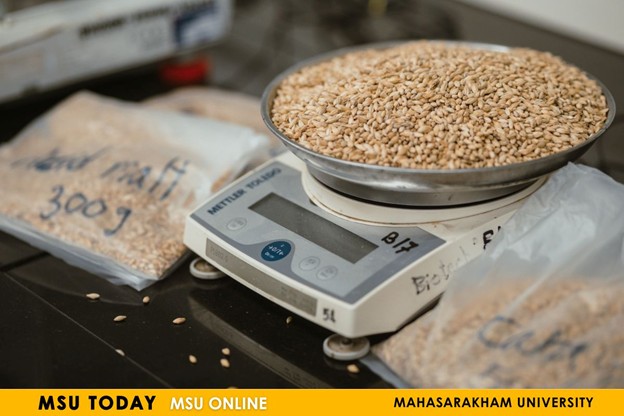
Milling :The malt is ground into smaller pieces, but not as fine powder. This step is crucial to break the malt’s outer husk while keeping the inside intact for the next steps.
Mashing :The milled malt is heated for about 60 minutes at around 67°C. This process converts starches into fermentable sugars like glucose and maltose.
Two types of malt are used: Base Malt (for starch) and Special Malt (for color and flavor).
The pH of malt is naturally around 5.8, which doesn’t require adjustments.
Lautering : After mashing, the wort (the liquid part) is separated from the remaining malt grains. The remaining sugar in the grain is extracted by rinsing the grain with hot water. The sugar concentration is checked using a Hand Refractometer to measure the amount of sugar left.
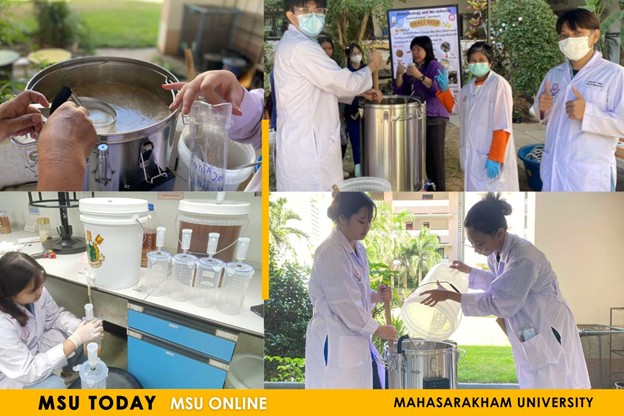
Boiling : Boiling the Wort: The wort (the liquid extracted from malt) is boiled at 100°C for 60 minutes. During this step, measurements are taken using a Hand Refractometer to determine sugar levels and Original Gravity, which helps calculate the alcohol content and bitterness.
Yeast Preparation: About 1% of the wort volume is set aside to prepare the yeast starter, placed in sterilized containers.
Adding Hops : Hops are added to the boiling wort to introduce bitterness and aroma. The timing and number of hops depend on the desired bitterness and fragrance.
Flavoring : To enhance the flavor, ingredients (such as fruit or additional spices) are usually added during the last 10 minutes of the boil.
Cooling : After boiling the wort for 60 minutes at 100°C, the next step is to cool it down rapidly to around 35-40°C. This is essential to prevent unwanted microbial growth and prepare the wort for fermentation.
Transfer to Fermentation Vessel: Once the wort is cooled, it is transferred into a sterilized fermentation vessel. The vessel is sterilized using a solution like Starsan, which is mixed with clean water. The solution is poured into the fermentation vessel and shaken to ensure that the entire vessel is sanitized. Additionally, all tools and equipment, including hoses, caps, and airlocks, should be sanitized by soaking them in the Starsan solution for at least 2 minutes.
Fermentation : Adding Yeast: Yeast is added to the cooled wort to begin fermentation. The fermentation vessel is sealed with a lid, and an Airlock is attached to the top of the vessel to allow gas to escape while preventing contaminants from entering.
Mixing: The fermentation vessel is shaken gently to ensure that the yeast is evenly distributed and that the mixture is well combined.
Fermentation Duration: The fermentation process typically lasts 14 days, depending on the type of yeast used. During this time, the yeast will consume the sugars in the wort and convert them into alcohol, while producing carbon dioxide gas.
Adding Fruit for Flavor: On day 4 of fermentation, fruit (like lychee or passion fruit) is added to enhance the flavor and aroma of the craft beer, giving it the desired unique characteristics.
Cold Crash : After 14 days of fermentation, a process called cold crashing is done to clarify the beer. The fermentation vessel is placed in a refrigerator at a temperature of 2-4°C for about 3 days. Purpose: This step helps the yeast and other particles to settle, making the beer clearer. Testing: During cold crashing, the Hand Refractometer is used to measure the sugar content and check the Original Gravity after fermentation to ensure the fermentation process is complete.
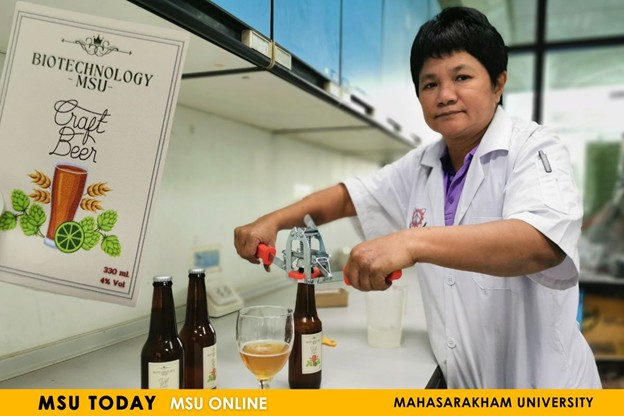
Priming Sugar : Purpose: Priming sugar is added just before bottling or kegging the beer. This sugar is consumed by the remaining yeast, which continues fermentation and produces carbon dioxide (CO2). Carbonation: This natural carbonation process creates the signature fizz or bubbles in the beer, giving it the desired effervescence and a balanced taste. Time and Temperature: After the priming sugar is added, the beer is left to carbonate at a controlled temperature (typically 2-4°C) for about 14 days.
Has it been implemented and how has it been received?
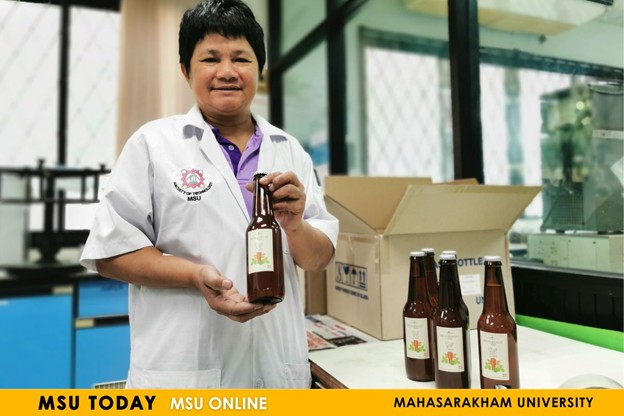
Currently, the product is being produced and sold to customers from the Bank for Agriculture and Agricultural Cooperatives (BAAC) as well as other interested individuals.
How is the quality of our product?
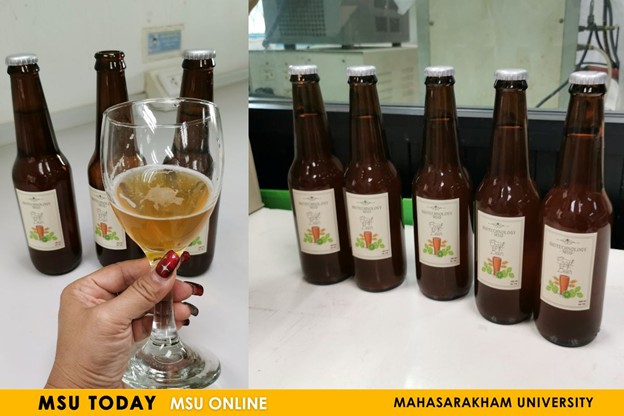
The product quality has been well received by consumers, particularly for its aroma and flavor.
Who is the target group for this research?
Beer consumers who prefer distinctive alternatives to mainstream beers, especially those appreciating the unique aromas and flavors of local fruits.
What are the challenges and obstacles in this work?
The production process requires fermentation chambers and refrigeration units, which are currently insufficient to properly control fermentation, sedimentation, and priming sugar stages, factors that directly impact craft beer quality. Additionally, the high cost of key ingredients like malt and hops presents a significant challenge.
Do we have any plans or policies to launch this product into the market?
Currently, we are selling the original and slightly modified hop recipes in small quantities, mainly as part of teaching activities. Since we have not yet obtained a commercial production license, the products are only sold to interested individuals. Moving forward, we plan to have customers test this new recipe and will discuss with the faculty about official product distribution, registration, and obtaining proper production and sales licenses.

What is the future direction of this research?
In the future, we plan to develop the recipe by incorporating herbs to increase the presence of beneficial active compounds. This will transform the beverage from being just an alcoholic drink into one that also provides health benefits from local medicinal herbs.
Message for young researchers:
There’s still a lot to explore in craft beer production, from the brewing process to the ingredients and yeast used. These areas hold great potential for reducing production costs and creating formulas that offer health benefits.
Editor: Office of International Affairs
ข่าวภาษาไทย (Thai article): https://news.msu.ac.th/msumagaz/smain/readpost.php?mid=650